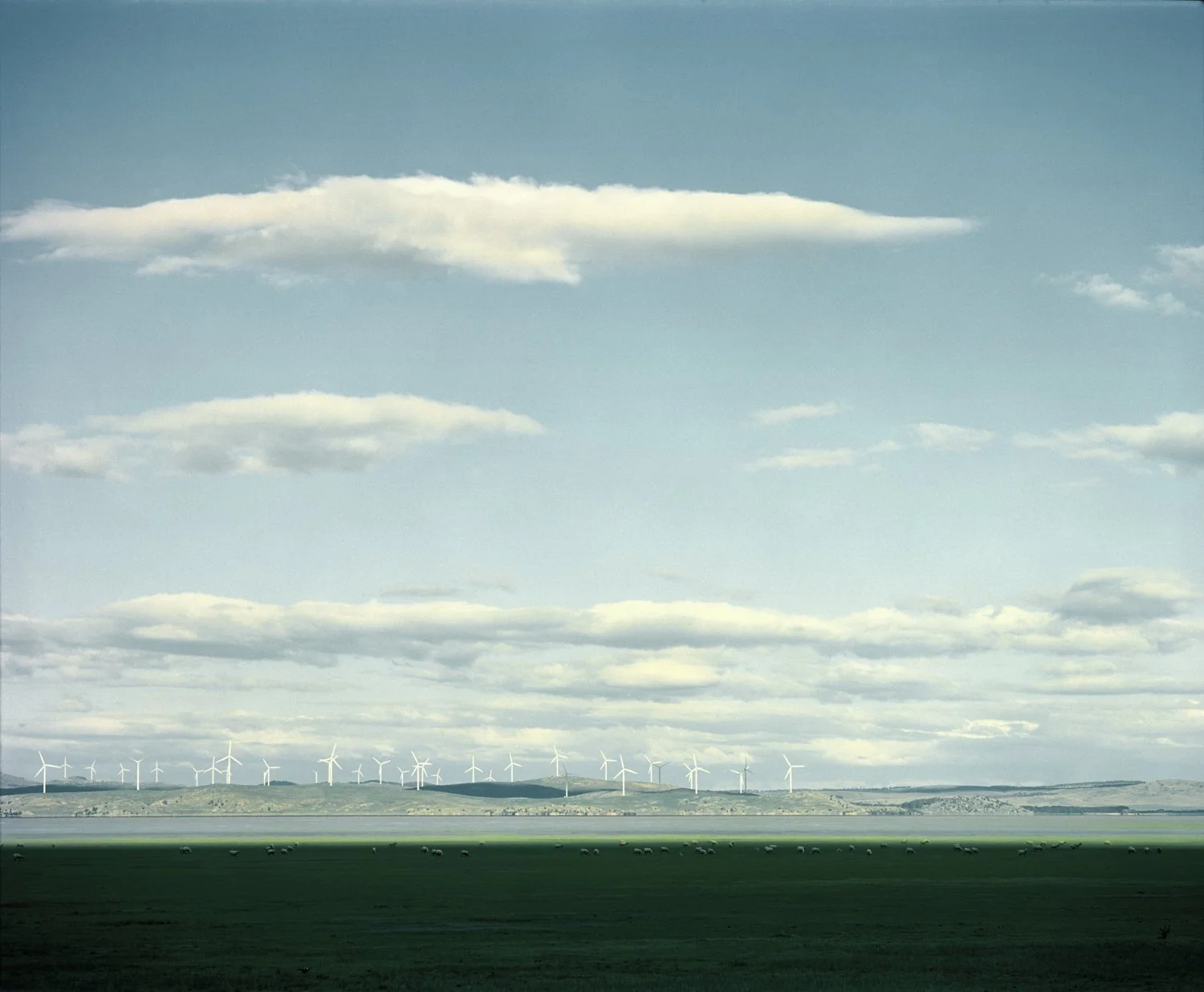
Lake George, 2017–2025
Taken through a car window on repeated journeys between Sydney and Canberra over nine years, these photographs were never made at the lake. They were made past it. I never stopped. The lake is always beside you, never in front. Lake George — Weereewa — is one of Australia's most ecologically unstable bodies of water, filling, retreating and disappearing entirely across seasons and years, and everyone who drives past is told so. It refused to hold still for any single definitive image. A photograph made on one journey shows water to the horizon. Another shows a dry plain. Both are Lake George. For nine years the lake was a marker on a route, the landform that meant almost there. What accumulates is not a portrait of a place but a record of the gap between how a landscape appears and what it is actually doing.
The wind turbines above the lake are part of the same inquiry. They are instruments reading what the eye cannot see: measuring wind, converting the invisible into something usable and legible. In this they perform their own kind of photography — a system of capture built into the landscape, translating ephemeral force into fixed, transferable energy.